
Commercial Roof Restoration Without the Tear-Off
Get More Years From the Roof You Already Paid For.
If your flat or low-slope roof is worn out on top but still sound underneath, restoration renews it in place. We'll tell you plainly whether your roof qualifies, and what the alternative would be if it doesn't.
Free Roof Inspection
Tell Us About Your Building
No obligation. You get photos and a written proposal with your options.
First question
Is Your Roof a Restoration Candidate?
Restoration is for roofs that are tired, not roofs that are finished. These are the signs we look for.
- A dry roof, mostly. Wet insulation can be cut out in sections, but if a large share of the roof is wet, replacing it usually makes more sense.
- A solid deck. The steel, concrete, or wood under the insulation has to be sound. Soft or sagging spots are checked closely.
- Leaks in predictable places. Seams, flashing, drains, curbs, and pipe penetrations are where restoration does its best work.
- A roof that still holds together. Membranes that are shrinking, splitting everywhere, or pulling off the edges are usually past restoring.
This applies to single-ply roofs such as TPO, PVC, and EPDM, to modified bitumen, and to built-up roofs with a gravel or smooth surface. Metal roofs follow a different process, which is covered on our metal roof restoration page.
Three options
Restore, Recover or Replace: How We Decide With You
Every worn roof has three paths. We lay out the ones that fit your roof and let you choose with the facts in front of you.
Restore
Clean and repair the existing roof, replace any wet sections, and apply a coating or fabric-reinforced system over it. The existing roof stays in place and keeps doing its job.
Best when the roof is mostly dry and the deck is solid.
Recover
Install new insulation board and a new membrane over the existing roof without tearing it off. Building codes limit how many roofs can be stacked, so this is only possible when the building has a single existing roof.
Best when the surface is worn past coating but the layers below are dry.
Replace
Tear the roof off down to the deck, repair the deck where needed, and install a new roof system from the deck up. It is the biggest project of the three.
Best when the insulation is widely wet, the deck is damaged, or the roof already has too many layers.
The decision comes from evidence, not a sales pitch. We share the moisture results, the photos, and the reasons behind our recommendation, and if replacement is the honest answer, our commercial roof replacement page explains what that project looks like.
How restoration works
Fabric-Reinforced Restoration Systems
On roofs with a lot of seams, cracks, or movement, a coating alone isn't enough. Reinforcing fabric gives the new membrane the strength to bridge them.
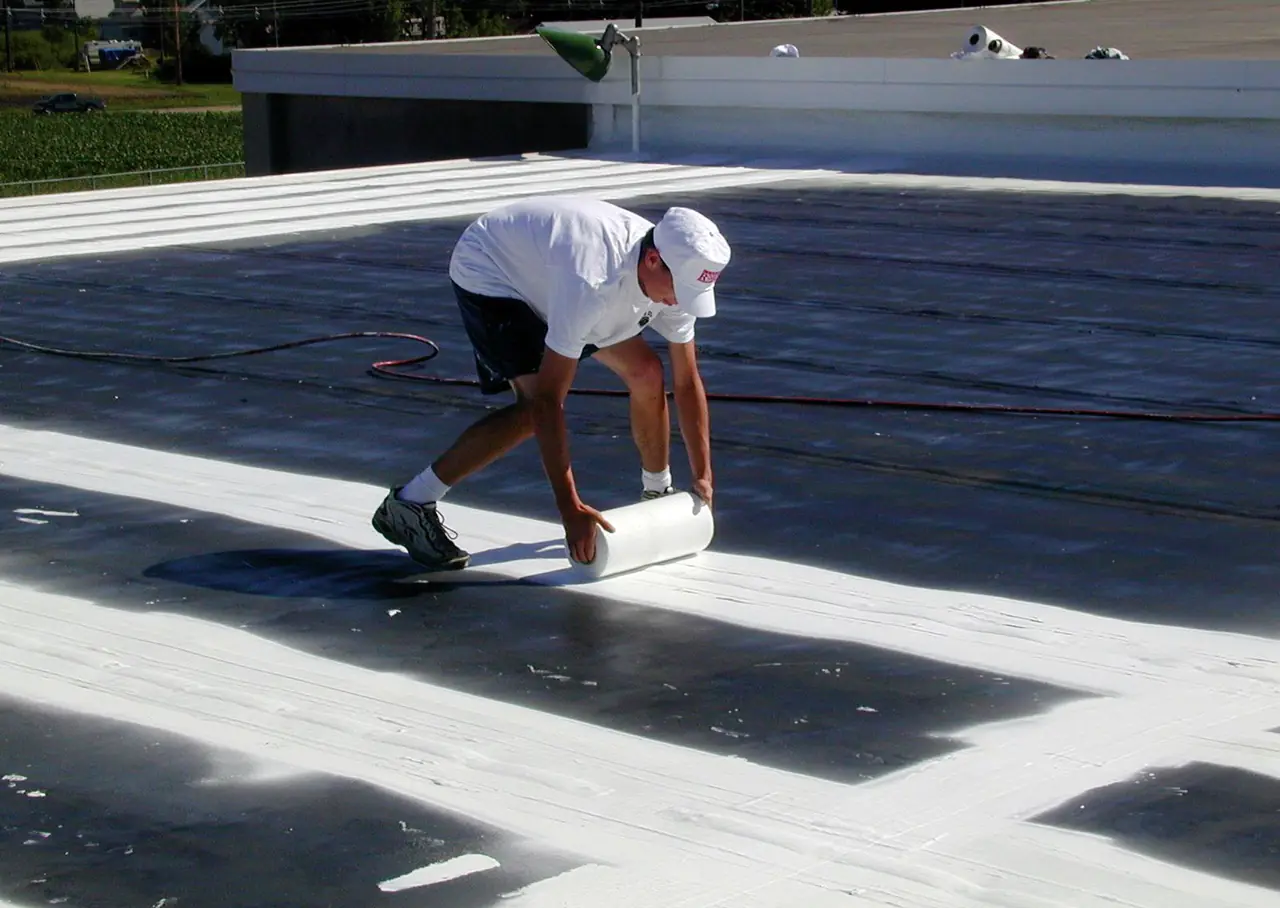
A fabric-reinforced system is built in layers. A base coat goes down, polyester fabric is rolled into it while it is still wet, and a top coat seals the fabric in. The result is a seamless membrane that is tougher than a coating applied by itself.
On some roofs we reinforce only the seams, flashing, and details. On roofs that are cracked or alligatored across the surface, the fabric goes over the whole roof. We'll tell you which approach your roof calls for and why. The exact steps depend on what the inspection finds.
Inspect the roof
We walk the roof, check its condition, and talk with you about what you need from it.
Put it in writing
You get a written proposal with your options and the scope of the work.
Install it the right way
We follow Conklin's recommended installation guides and industry best practices on every job.
Built for this climate
Flat Roof Restoration for Upstate Winters
Flat roofs in the Mohawk Valley take a beating that roofs farther south never see. Snow sits on them for weeks. Meltwater refreezes at the edges and in low spots. Every freeze-thaw cycle opens small cracks a little wider, and spring rain finds them.
That is why we pay close attention to drainage and details on a restoration. Low spots that hold water are corrected where possible, drains and scuppers are cleared and resealed, and the edges and flashing that ice works on hardest get reinforced.
Restoration work is scheduled for the warmer, drier months, because the coatings need dry conditions and mild temperatures to cure. A fall inspection lets you get on the schedule early.
The business case
What Restoration Means for Your Budget and Your Building
For a roof that qualifies, restoration is usually the less disruptive and less costly path. Here is what that means in practice.
Less disruption
The roof stays on, so there is no open deck, no tear-off debris coming down, and much less noise. Most buildings stay fully open while the work is done.
Lower up-front cost
Because the existing roof stays in place, you aren't paying to remove and dispose of it, and the project usually takes less time. The actual cost depends on how much of your roof needs repair first.
General industry ranges for illustration only. Your free inspection gives you real numbers for your building.
A longer life for the roof you have
A restored roof can later be cleaned and recoated, which can push the next major roof project well into the future.
A restoration coating can extend the service life of a sound roof. Results depend on the roof's condition, the system used, and maintenance.
Energy and taxes
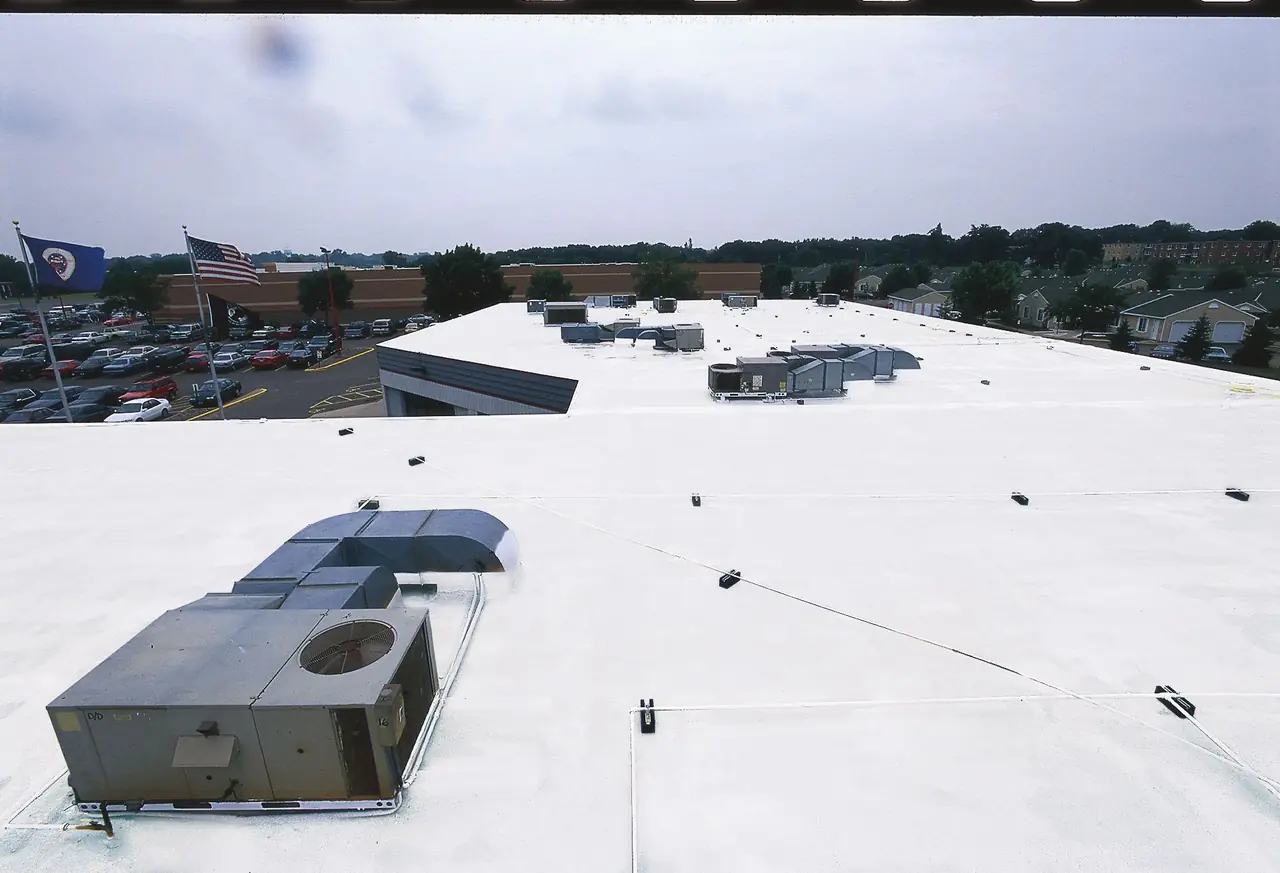
A white restoration system reflects more of the sun's heat than a dark or weathered roof. Some owners also find that restoration work is treated differently from a full replacement for tax purposes.
Reflective roof coatings may help reduce cooling costs. Actual savings depend on the building, climate, and existing roof. Talk to your tax professional about how roof work may affect your taxes. This is not tax advice.
Warranty coverage
Depending on the system, a restoration can come with up to a 20-year material warranty backed by Conklin Roofing Systems, with maintenance plans available.
Warranty terms vary by system and project; ask for details.
Questions
Restoration FAQs
Should I restore or replace my commercial roof?
Restore it if the deck is solid, most of the insulation is dry, and the problems are concentrated at seams, flashing, and penetrations. Replace it if water has soaked large parts of the insulation, the deck is damaged, or the membrane is failing across the whole roof. We base the recommendation on what we find on your roof, and we show you the photos and moisture results that support it.
My roof is about 20 years old. Is it too old to restore?
Age alone doesn't decide it. A 20-year-old roof that has been maintained and is mostly dry can be a good restoration candidate, while a 10-year-old roof that has been leaking for years may not be. The condition of the insulation and deck matters far more than the date it was installed.
How often does a commercial roof need to be replaced?
There's no single schedule. It depends on the roof system, how it was installed, the weather it sees, and how well it has been maintained. Restoration can change the timeline, because a sound roof that is restored before it fails may not need to be torn off for a long time.
A restoration coating can extend the service life of a sound roof. Results depend on the roof's condition, the system used, and maintenance.
What is a fabric-reinforced restoration system?
It is a restoration in which a polyester fabric is embedded between layers of liquid coating. The fabric works like the steel in reinforced concrete: it adds strength, helps the system bridge seams and small cracks, and makes the finished membrane tougher. It can be used at seams and details only or across the whole roof.
Service area
Where We Offer Commercial Roof Restoration
We're based in Fort Plain, NY, and serve commercial buildings within about 100 miles, and farther when a job calls for it.
Related services
- Commercial Roof CoatingsA seamless Conklin acrylic coating that seals the surface and reflects sunlight.
- Commercial Roof ReplacementA complete tear-off and new roof when restoration is not the right fit.
- Commercial Roof RepairFind the real source of a leak and fix it, so you stop paying for the same repair twice.
Your next step
Get an Honest Restoration Assessment
We'll inspect your roof, check it for moisture, and tell you honestly whether restoration, a recover, or a replacement fits it best. You'll get photos and a written proposal within 24 to 72 hours of the inspection.
Call or text (518) 612-0001. We respond within 24 to 48 hours.